


Most enterprises believe they have control over AI. In reality, they are operating with limited visibility, fragmented policy enforcement, and expanding exposure. Artificial Intelligence is scaling faster than any prior enterprise technology shift.
Organizations are already deploying GenAI broadly and building internal Agentic platforms, yet many lack a coherent strategy to manage risk, enforce policy, and operationalize control. This paper outlines an outcome-based model for security, risk, and technology leaders to enable business competitiveness through safe AI adoption.
If you cannot see how AI is being used, you cannot operationalize it.
The Reality and Risk of Enterprise AI Adoption
AI adoption is moving along an accelerated, evolving S-curve, driven by the convergence of accessible models and AI-reinforced development that have dismantled traditional barriers to entry. Decentralized individual usage, 90% of which is unsanctioned, has driven gains in productivity. Boards and executives have taken notice, and are mandating AI adoption. Consequently, AI is being woven into enterprise workflows, decision-making, and customer interactions at an unprecedented pace.
In this high-pressure environment where innovation accelerates, but visibility, governance, and control lag behind, we see organizations defaulting into three common operating patterns:
- Unfettered Adoption: Quick adoption without structured control delivers short term gains, but introduces unmanaged and invisible risk.
- Reactive Management: Addressing issues as they emerge results in fragmented, unscalable solutions that increase medium term operational complexity.
- Strategic Procrastination: Delaying meaningful engagement while waiting for stable standards to emerge delays learning while AI continues to evolve rapidly.
Waiting to build an AI governance strategy is a competitive choice.
The Three Mandates of the Modern Security Executive
For CISOs, CSOs, CIOs, and CTOs, AI introduces a set of overlapping responsibilities:
- Enable Business Competitiveness: Move from "No" to "Yes and here is how" on AI adoption, turning governance into a catalyst for innovation.
- Defend the Enterprise: Protect against a dual-threat landscape: AI-driven attacks on traditional infrastructure and new categories of attacks targeting AI applications (e.g. prompt injection, data poisoning).
- Transform Operations: Modernize the security, risk, and privacy functions by leveraging AI to improve speed, detection, and service delivery.
Why AI is Fundamentally Different
Modern AI applications are built around trained neural networks like LLMs that differ substantially from traditional software:
- The Black Box Issue: A trained neural network is a collection of billions of weights whose intent cannot be interpreted by "reading weights" like a human could read code. A large model cannot be pre-tested exhaustively.
- The Variability Issue: Traditional code produces the same result each time. Models produce probabilistic results based on statistical likelihoods, meaning they can produce variable responses to similar queries and are suggestible to variations in prompting.
- The Permissioning Issue: Old software workflows relied on deterministic interactions with explicit permissions. Agentic workflows are different; an AI orchestrator spontaneously designs a path to solve a query, consuming and conveying data across systems without a pre-defined permissioning map.
- The Speed Issue: AI is 100x faster than humans, is untiring, and can generate beneficial or catastrophic results at a speed that human oversight can never match.
AI agents are like people — they need real-time supervision.
The Operational Confidence Layer for AI
When adopting AI, the core business-related operating agreements and policies of an enterprise must remain inviolable. To meet this requirement and the modern security mandate, organizations must establish an Operational Confidence Layer for AI—a reference AI policy architecture combined with operational capability that provides visibility, control, and enforcement across all AI usage. Crucially, the layer acts as a strategic decoupling point:
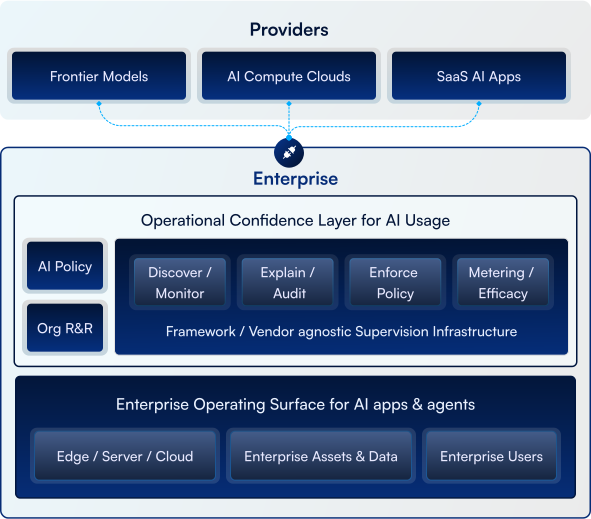
- It ensures portability, resilience, and consistency of enterprise policy enforcement across the full spectrum of AI manifestations on company infrastructure—sanctioned or unsanctioned, employee personal or business AI, internally developed or vendor-supplied.
- It ensures that the enterprise retains ultimate authority and custodianship over its data and actions, while providing strategic optionality across AI providers.
You buy the AI, but you must control your Operational Confidence Layer.
Core Supervisory Capabilities of the Confidence Layer
The Operational Confidence Layer is not a single view but a coordinated set of supervisory capabilities that create a control plane for the organization:
- Discovery (The 3 C's): Provides detection of sanctioned and "shadow" AI, continuously mapping the Connectivity, Configuration, and Credentials of every AI system into a live Enterprise AI Posture Map.
- Explainability & Auditability: Traces AI-driven outputs and actions while surfacing insights around intent, identity, chain of custody, and data lineage, providing the forensic trail necessary for compliance.
- Operational Security: Utilizes Policy-as-Code integrating with existing infrastructure to enforce rules consistently. ML automation allows policies to be updated and deployed at machine speed, incorporating "human-in-the-loop" governance where critical.
What Leaders Should Do Now
Recognize and communicate the strategic importance of the confidence layer as competitive differentiation for your company. Get executive buy-in, form a cross-functional task force, and start:
- 01 Begin with AI discovery: Know what’s running. Without the foundation of AI discovery, any attempt to define policy or control risk is guesswork.
- 02 Assess your AI threat model: Understand the difference between traditional software risks and AI-specific vulnerabilities.
- 03 Codify policy early: Start with basic guardrails, then iterate. ML-based classification makes enforcement scalable.
- 04 Build the operational confidence layer: Standardize policy enforcement across all applications, models, and agents.
- 05 Modernize your operational workforce: Recognize that AI requires new oversight roles, and train your teams to manage agentic workflows and automated ML systems.